



The outsourcing world is defined by two powerful models: staff augmentation and managed services. Both help businesses navigate evolving IT demands, but they shape control, accountability, and scalability in fundamentally different ways.
IDC forecasts a brutal reality by 2026. Over 90% of companies will buckle under the IT skills crunch, bleeding a staggering $5.5 trillion worldwide. On the other hand, global spending on IT outsourcing is projected to reach $806.55 billion by 2030. That surge reflects a broader shift: businesses everywhere are rethinking how they deploy resources to stay agile, efficient, and resilient.
This blog explores the tension and trade-offs between these two models—flexibility vs structure, control vs delegation, and how choosing wisely can reshape your business performance for the future.
Rethink How You Scale with AlphaKOR!
What Drives the Staff Augmentation vs Managed Services Debate
At its core, the staff augmentation vs managed services conversation is about how businesses define ownership of expertise.
Some organizations want to scale fast without the overhead of permanent hires. Others prioritize accountability, uptime, and long-term stability. The choice reflects both operational needs and strategic intent.
Companies turn to outsourcing for reasons like:
- Widening skill gaps in IT and cybersecurity
- Complex projects that demand specialized, short-term expertise
- Cost pressures that make full-time hiring less practical
For IT leaders, this isn’t just a staffing decision; it’s a structural one.
It determines:
- How flexible your teams can be
- How much control you retain internally
- How resilient your systems become over time
Both models thrive today because they speak to two distinct priorities:
- Speed and specialization (staff augmentation)
- Structure and continuity (managed services)
Understanding what drives this debate helps leaders choose not just a model—but a mindset for growth.
What Is Staff Augmentation and Why Does It Still Work?
Staff augmentation is the practice of extending your internal team with external professionals for a defined period. You stay in control, managing systems, workflows, and outcomes, while gaining instant access to specialized skills.
The IT staff augmentation market is on track to skyrocket past $857.2 billion by 2031. Organizations often turn to this model when they’re facing time-sensitive demands or need to fill temporary gaps without the overhead of permanent hiring. It’s a practical solution for fast-moving environments where agility matters most.
Common reasons businesses choose staff augmentation include:
- Meeting tight project deadlines
- Handling temporary spikes in workload
- Accessing niche technical expertise without long-term hiring
The appeal lies in its flexibility. You get the talent you need, when you need it, without reshaping your entire team. That translates into several key benefits:
- Direct oversight of your team and deliverables
- Cost-effective access to targeted skills
- Ability to scale talent up or down without long-term commitments
Of course, this model isn’t without its challenges. While you gain flexibility, you also retain full responsibility for coordination and performance. That means:
- Management burden stays in-house
- Success depends on strong internal leadership
Consider this scenario where a software firm in Ontario lands a major app development contract. Instead of hiring full-time developers, it augments its team with vetted talent for six months. The result? Faster delivery, leaner operations, and no long-term overhead. That’s proof that staff augmentation keeps teams light, agile, and focused.
What Are Managed Services and When to Choose Them
Managed services take outsourcing a step further. Instead of hiring individuals, you delegate entire processes to a third-party provider. This isn’t about filling seats; it’s about transferring responsibility.
In this model, your managed service partner (MSP) owns delivery, monitoring, and accountability. You shift your focus from managing tasks to measuring outcomes.
That shift brings several advantages:
- Predictable monthly costs through service-level agreements (SLAs)
- Access to broad expertise across IT, security, and cloud operations
- Continuous monitoring that reduces downtime and operational risk
But like any model, it comes with trade-offs. While you gain structure and reliability, you also give up some direct control. That can lead to:
- Reduced hands-on oversight
- Potential cultural or communication gaps if alignment isn’t strong
Consider this scenario where a manufacturing company in Windsor partners with a managed IT provider to oversee 24/7 infrastructure monitoring. The internal IT team focuses on innovation, while the MSP ensures uptime and cybersecurity resilience. It’s a win for both focus and continuity.
| The $441.1 billion managed services surge forecasted for 2025 isn’t about maintenance; it’s about mindset. MSPs that lead with strategy, not service tickets, are defining the next era of growth. |
Managed Services vs Staff Augmentation: Which Delivers More Value?
The debate between managed services and staff augmentation often centers on four practical dimensions that shape how businesses operate and grow.
| Criteria | Staff Augmentation | Managed Services |
|---|---|---|
| Control | You manage projects directly and oversee talent | The provider manages all operations end-to-end |
| Cost | Pay per resource or hourly basis, flexible in the short term | Fixed monthly fees, predictable and strategic |
| Scalability | Easy to expand or reduce team size fast | Scales seamlessly with defined service agreements |
| Accountability | You own project outcomes | Provider assumes responsibility through SLAs |
There’s no universal winner; only alignment. Fast-moving teams often lean toward staff augmentation for agility, while organizations focused on long-term efficiency tend to favor managed services.
Staff augmentation truly shines when flexibility is your competitive edge. Startups, agencies, and digital product companies often rely on it to scale quickly without locking into long-term commitments.
It’s especially effective in scenarios like:
- Software development or migration projects with tight timelines
- UX/UI redesigns requiring temporary specialized designers
- Cloud integration efforts needing short-term architecture expertise
Financially, it’s a lean model. You pay for skills, not idle capacity. The ROI is immediate: results without expanding payroll or infrastructure.
| More articles you might like: |
When Managed Services Outshine Staff Augmentation
Managed services dominate when your goal is stability and scale. They remove day-to-day operational noise, freeing your internal team to focus on strategy, innovation, and growth.
This model delivers value through several key advantages:
- End-to-end infrastructure management
- Continuous security monitoring and proactive issue resolution
- Standardized processes that maintain uptime and compliance
It’s especially effective in environments where consistency matters. You’ll often see managed services applied in:
- IT infrastructure support and helpdesk management
- Cybersecurity oversight with 24/7 response
- Cloud hosting and optimization
For example, a logistics company might rely on a managed service provider to oversee its entire IT ecosystem. The result? Business continuity improves, internal IT load decreases, and productivity rises, a clear win for focus and resilience.
Key Factors to Consider Before Choosing Between Staff Augmentation and Managed Services
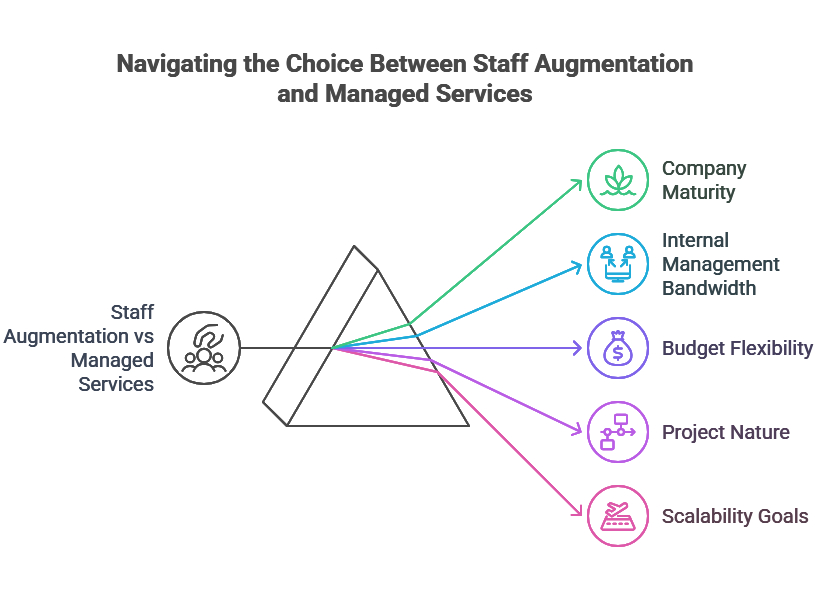
Before committing to either model, it’s important to evaluate a few critical factors that shape long-term success.
These considerations can help guide your decision:
- Company maturity: Established firms often need structured managed services, while growing startups benefit from flexibility
- Internal management bandwidth: If your team can’t supervise contractors, managed services may be a better fit
- Budget flexibility: Consider whether you prefer project-based spending or predictable monthly billing
- Project nature: Time-bound tasks fit augmentation; ongoing maintenance suits managed services
- Scalability goals: Long-term vision should guide your choice, not just immediate needs
Your decision defines how your business scales its expertise, and how much of that control you choose to keep in-house.
Blending Managed Services and Staff Augmentation for Maximum Impact
Smart organizations no longer choose between staff augmentation and managed service; they blend both. It’s not a compromise; it’s a strategy.
They might use staff augmentation for development bursts, product rollouts, or seasonal spikes, while relying on managed services for 24/7 IT operations and infrastructure continuity.
This hybrid setup delivers a powerful combination:
- Flexibility for innovation
- Stability for critical systems
- Balanced cost control across the organization
Forward-thinking companies use this mix to stay resilient and agile. By layering the right partnerships, they protect uptime while still evolving quickly, without overextending internal teams.
The Future of Outsourcing Beyond Staff Augmentation and Managed Services
Outsourcing is entering a new phase. Artificial intelligence, automation, and analytics are reshaping how businesses engage external talent and services.
AI-driven service management and predictive staffing models are making outsourcing proactive and intelligent. It’s no longer just about cutting down on cost. It’s about performance, foresight, and strategic alignment.
Businesses that treat outsourcing as a partnership, not a transaction, will lead this transformation. The line between staff augmentation and managed services will blur, replaced by dynamic, on-demand collaboration ecosystems.
To measure success in this new landscape, organizations are tracking more than just delivery speed or cost savings. They’re focusing on metrics that reflect true business impact:
| Metric | Description | Why It Matters |
|---|---|---|
| Response Time | Average time to address IT issues | Reflects service quality and operational readiness |
| Innovation Index | Number of new tech initiatives launched per quarter | Measures how outsourcing fuels innovation |
| Employee Productivity Gain | Percentage increase in output post-outsourcing | Shows real business impact beyond IT |
| Risk Reduction Rate | Frequency of major incidents before vs after | Proves ROI in stability and security |
| SLA Compliance | Percentage of service targets met by the provider | Ensures accountability and trust |
Tracking these metrics ensures outsourcing decisions drive tangible performance outcomes, not just convenience.
Break the Support Cycle! Scale Smarter with AlphaKOR
Choosing between staff augmentation and managed services isn’t about picking sides—it’s about aligning your IT strategy with your business goals.
If your organization values agility and short-term flexibility, staff augmentation can deliver quick wins. But when long-term stability, scalability, and accountability matter most, managed services offer the strategic edge.
As a trusted managed services provider with over three decades of experience and an 89% same-day issue resolution, AlphaKOR helps businesses move beyond reactive support into proactive performance.
Whether you’re modernizing infrastructure, securing operations, or scaling with confidence, AlphaKOR brings the structure, expertise, and reliability to make it happen.
Trusted Managed IT Services Near You
| London, ON | Mississauga, ON | Windsor, ON |
Contact us today to explore how managed services can elevate your IT strategy and fuel your next phase of growth.
