

Index
- Understanding Data Breach Responsibility
- Recent Trends in Data Breaches Impacting Businesses
- Common Causes of Data Breaches
- Industries Most Impacted by Data Breaches
- Best Practices for Preventing and Managing Data Breaches
- Tools and Services for Data Breach Prevention and Response
- AlphaKOR’s Role in Supporting Data Breach Responsibility and Cybersecurity
Understanding Data Breach Responsibility
A data breach occurs when sensitive, protected, or confidential information is accessed or disclosed without authorization. Determining responsibility for a data breach is often complex, involving multiple stakeholders, legal obligations, and operational accountability. From a cybersecurity perspective, responsibility encompasses both the technical and organizational measures required to prevent, detect, and respond to breaches.
Business leaders, IT departments, and third-party vendors can all share responsibility depending on the nature of the incident. Executives are accountable for ensuring that proper governance and risk management practices are in place, while IT teams are responsible for implementing security controls, monitoring systems, and responding to incidents. Regulatory frameworks such as GDPR, CCPA, HIPAA, and industry-specific requirements codify responsibilities and can impose financial or legal penalties if organizations fail to safeguard data adequately.
Ultimately, responsibility is not only legal but ethical, as businesses are expected to protect customer, employee, and partner information from harm.
Recent Trends in Data Breaches Impacting Businesses
Data breaches have increased dramatically in frequency and scale. In 2023, there were over 5,000 publicly reported breaches globally, exposing billions of records across multiple sectors. Attackers are increasingly sophisticated, targeting cloud environments, IoT devices, and third-party vendors to bypass traditional defenses.
Ransomware attacks remain a dominant driver of data breaches, with estimates suggesting that over 60% of successful ransomware incidents involve the encryption or theft of sensitive business data. Additionally, phishing, credential theft, and insider threats continue to play a central role in breaches, highlighting the need for comprehensive cybersecurity programs that combine technical, procedural, and human-focused defenses.
Legal accountability is also evolving. Regulators are increasingly holding organizations liable for failing to protect data, imposing substantial fines, mandatory reporting requirements, and, in some cases, criminal charges. This trend reinforces the importance of clear lines of responsibility within business operations.
Common Causes of Data Breaches
Data breaches typically arise from a combination of human, technical, and procedural failures. Phishing attacks and social engineering are major contributors, exploiting human trust to gain access to credentials or systems. Misconfigured cloud environments, unpatched software vulnerabilities, and weak access controls frequently allow attackers to infiltrate business networks.
Insider threats, whether intentional or accidental, can also result in significant breaches. Employees may inadvertently expose sensitive information through email errors, unsecured file sharing, or mishandling of devices. Similarly, third-party vendors and contractors represent a shared responsibility, as their cybersecurity posture directly impacts the organizations they support.
From a cybersecurity standpoint, data breaches are often the culmination of multiple small lapses, making prevention, monitoring, and rapid response critical to minimizing damage.
Industries Most Impacted by Data Breaches
Some industries face higher stakes and regulatory scrutiny, increasing the consequences of a data breach. Retail and e-commerce companies are frequent targets due to large volumes of payment card information and personal customer data. Energy and utilities providers face operational and safety risks if breaches compromise control systems or critical infrastructure.
Education institutions and research organizations are also at elevated risk, handling sensitive student, faculty, and research data that can be exploited for identity theft or intellectual property theft. Telecommunications providers manage vast amounts of customer data, and breaches can disrupt communication networks, leading to both financial and reputational damage. Insurance and logistics companies, reliant on complex data systems for claims, shipping, and customer records, must also maintain high levels of cybersecurity to avoid operational disruption.
By understanding these sector-specific risks, businesses can assign clear lines of responsibility and prioritize security measures where they are most impactful.
Best Practices for Preventing and Managing Data Breaches
Preventing data breaches begins with a holistic approach to cybersecurity, combining technology, processes, and human factors. Organizations should implement multi-layered defenses, including endpoint protection, firewalls, intrusion detection, and network segmentation. Regular patching, secure access controls, and encrypted data storage are foundational technical measures.
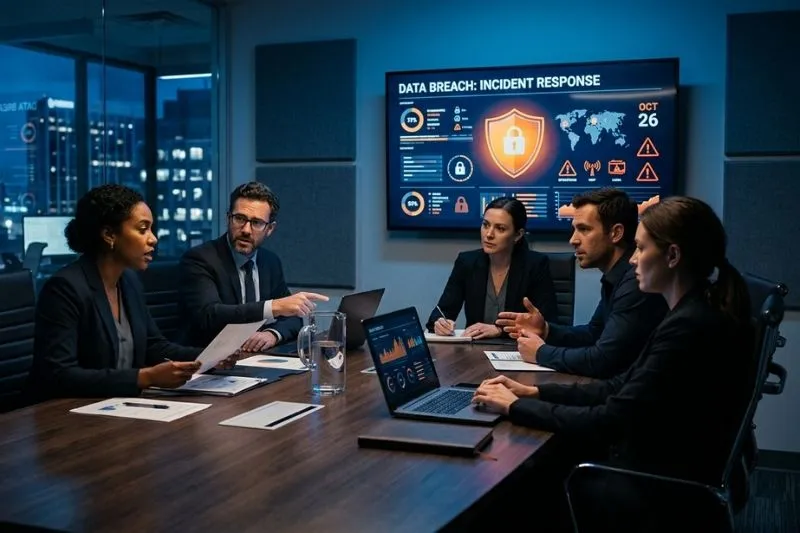
Employee training and awareness programs are equally important, focusing on phishing recognition, secure password practices, and proper handling of sensitive information. Incident response plans should be clearly documented and regularly tested, ensuring that business leaders, IT teams, and legal advisors understand their roles during a breach.
For management, accountability frameworks should define who is responsible for prevention, detection, response, and regulatory compliance. Transparent communication channels, clear reporting structures, and continuous monitoring help businesses detect breaches early and respond efficiently, mitigating financial, operational, and reputational harm.
Tools and Services for Data Breach Prevention and Response
A variety of tools support businesses in preventing and responding to data breaches. Endpoint detection and response (EDR) platforms monitor devices for anomalous behavior, providing real-time alerts. Security Information and Event Management (SIEM) systems aggregate logs across networks to identify potential threats.
Identity and access management tools, including multi-factor authentication and single sign-on, reduce the risk of unauthorized access. Data loss prevention software monitors the movement of sensitive information, while secure backup and recovery solutions ensure data integrity even in the event of a breach.
Many businesses also rely on managed security service providers (MSSPs) to supplement internal capabilities, providing 24/7 monitoring, threat intelligence, and rapid incident response support. Integrating these tools into a cohesive cybersecurity framework ensures that responsibilities are clear and that breaches can be managed efficiently.

AlphaKOR’s Role in Supporting Data Breach Responsibility and Cybersecurity
AlphaKOR Group assists organizations in defining and implementing clear lines of responsibility for data breaches. AlphaKOR evaluates business processes, IT infrastructure, and third-party dependencies to identify vulnerabilities and implement preventive measures.
For industries such as retail, energy, education, telecommunications, and insurance, AlphaKOR delivers tailored cybersecurity solutions including endpoint protection, identity and access management, SIEM monitoring, and secure backups. By establishing robust technical and procedural controls, AlphaKOR ensures that businesses can demonstrate due diligence in the event of a breach, satisfying regulatory obligations and minimizing financial exposure.
Beyond prevention, AlphaKOR supports incident response planning and breach simulation exercises, preparing business leaders and IT teams to act decisively. This integrated approach ensures that responsibility is clearly assigned, controls are effective, and businesses can recover quickly while maintaining stakeholder trust.
Conclusion
Responsibility for a data breach is shared across executives, IT teams, employees, and third-party partners, with regulatory frameworks increasingly codifying accountability. Understanding where responsibility lies, implementing robust cybersecurity measures, and establishing clear incident response protocols are essential for mitigating risk.
Partnering with expert providers such as AlphaKOR ensures that businesses are not only compliant but resilient, with clearly defined roles, strong technical controls, and effective recovery strategies. In today’s threat landscape, assigning responsibility and preparing for potential breaches is critical to protecting data, finances, and reputation.
